New cider range for Hush Heath

March 15th, 2013

Engish Terroir has created a new range of Still and Bottle-fermented cider at Hush Heath.Made from apples grown on the Estate and vinified and bottled at the Winery. The ciders are made from pure apple juice , cool fermented in Stainless steel for a wine like character. Bottled in 75 cl bottles and marketed under the Jake’s Tree label.

The Jake’s Tree range from Hush Heath

The still range constists of a pure apple cider bottled in a green burgundy bottle and screw cap and a Strawberry and Blackcurrant friut cider both at 5.4%. The bottle- fermented ciders made in the traditional “champagne method” can be found with nettle and strawberry and blackcurrant , both in clear glass  and mytig corks and at 7.5%

Balfour 2009

January 31st, 2013

The exciting thing about vintage wines, such as the Balfour, are the way they evolve and reveal and reflect the vintage year. The 2009 Balfour Brut is now in wider circulation after a brief Silver Medal showing at last years Olympics.

The 2009 harvest itself took place over 2 days , on the 11th and 12th of October at Hush Heath. Unusually the Chardonnay was earlier than the Pinots with higher sugar (81 oc ) and lower acid (10.6g/l) . The Pinot Noir and Meunier came in at 77 oc and 11.6 g/l , pretty well perfect in other words.

The winemaking followed the usual course, cool separate ferments with a short 6 day separate red ferment for the Pinot Meunier . The final blend worked out at 52% Pinot Noir, 37% Chardonnay and 11% Pinot Mernier, a somewhat higher proportion than usual and a rather deeper pink .

The wine was bottled in July 2010.

From its comparativly youthful beginnings 2009 Balfour Brut is now a wine showing itself in its finest condition. The wine has now been on its lees for over 2 1/2 years . The wine was selected for the Olympics and the ffirst batch was disgorged in March 2012. Since then it has been disgorged on demand at the Hush Heath Winery, giving 3 months on the cork before sale.

A deeper pink than previous vintages, reflecting the higher proprotion of Mernier. The bead is fine and sustained both in the glass and mouth. The nose is slightly creamy,hints of white pepper, dried herbs. The palate is gloriously complex and full, malted shortbread,orange citrus, cooked strawberry and white chocolate . It finishes freshly and long, raspberries and cream.

Decanter – Silver medal winner

Saints alive

January 25th, 2013

When it comes to Saints and wine there is a fair amount of choice and with clever planning it would be possible to be legitimately drunk for up to a dozen days a year . One has to wonder what the wine connection is  with some of them, being grilled on a gridiron seems to have been a popular start.A martyrs death is almost a prerequisite . St Vincent of Saragossa is a case in point, popular in Burgundy , the patron saint of wine and vinegar makers , his day is the 22nd of January , probably not my choice.

More interesting might be St Trifon Zarezan, a Bulgarian vine grower whose meeting with the Vigin Mary  caused him to prune his own nose. Otherwise known as St Trifon the  Drunkard or St Trifon the snub nose , he is much more my style and is so popular that his day is often celebrated twice (for 3 days!?) on the 1st or 14th of February  using the old and new calendar dates. The 1st of Feburary being the traditional date for the start of pruning. (English growers take note) . The more wine poured on these dates the bigger the next harvest.

For those of you who can’t wait for a fortnight St Armand of Maastricht comes to the rescue on the 6th of February . Patron of brewers,innkeepers ,bar-tenders,vine growers, vintners,wine merchants and rather bizarrely Boy-Scouts.

February is a bit crowded  it has to be said , the 17th gives us St Walter of Portnise.

Followers of the orthodox calendar can enjoy  St Nicholas of Myra ( Santa Claus ) on the 9th of March or alternatively on the 6 th of December, St Nicholas is also the Paton saint of Liverpool.

Appropriately there is now a gap until the 3rd of June when St Marand is remembered, chiefly for surviving the whole of Lent on a bunch of grapes. (The miracle of the source of the grapes is not revealed.)

In July we have St Goar of Aquataine  on the 6th and St Urban of Longres on the 23rd. St Urban has some connection and reason to be thankful as he hid in a vineyard to avoid persecution. Not sure how it panned out in the end.

The meteor shower that falls from the Swift Tuttle comet around the 10th of August are know (to some) as “the burning tears of St Lawrence ” . St Lawrence of Rome is another who met his end on the gridiron. Keeper of the Holy Chalice, patron Saint of the  cider making Ampleforth monks, he is more traditionally linked with cooks and chefs.The reliquary containing his burnt head is apparently to be found in the Vatican .

St Martin of Tours, the patron of winegrowers and beggars (appropriately enough)was the first non martyr to become a saint. His day can be  celebrated without guilt on the 8th of November .

If you have not had enough over Christmas, St. John the Apostle gives you an opportunity on the 27th of December or for the Greeks  the 8 th of  May.

Happy drinking.

.

2012 Harvest

January 17th, 2013

2012 will go down as one othe most challenging vintages in the history of recent English winemaking. It was always going to to be difficult, poor weather at flowering in 2011 meant a high probability that the initation ( potential crop) was suspect . ( same again in 2013?) . Frost had been a problem in 2011 and was to prove to be in 2012 as well. At Hush Heath a determined effort was made to ensure this did not happen again. Extra buds (longer canes) were left on the vines, sacraficial cane were left untied down, several hundred boujies( very large and smokey candles) were laid out in the most vunerable parts of the vineyard.

For those of you with short memories 2012 actually started out as a drought in the South East, only 4 mm of rain fell in February and 20 mm in March. A hosepipe ban was in the offing. Early warmth was pushing the vines to an eeven earlier bud burst than last year. As it was , budburst in the Chardonnay (HH) started on the 2nd April , five days earlier than 2011 and a good two weeks ahead of a ‘normal’ year. The date coincided with a frost of -1.6 C . The turners and Victoria were given the opportunity to light the pots on 3 more occasions.

From this early start the vineyards accoss the SE seemed to go into a state of suspended animation, nothing happened, nothing grew for weeks. Over 100 mm of rain  fell in April (2011 we had 1.2mm) the average temperature for the month was 7.5c , 4 degrees lower than 2011.

To true affect of the frosts / poor initiation began to show through in May and July . There was a high proportion of blind bud, particulary in the middle of the canes, together with a lot of secondary canes. Temperature were surprisingly higher than 2011, and with record levels of rainfall ( over 250mm in these three months), spraying and vineyard work was very difficult and woe betide anyone without a robust and timely spay program.

Flowering again was rather extended, difficult to say when it started or finished, the set was pretty variable with marked differences between varietals and vineyards. Vineyards in Essex and SE Kent were markedly better than Sussex or Hampshire where the nascent bunches seemed to disappear .

Extra canes and buds proved their worth as had bee expexted not all the buds proved fruitful. At Hush Heath it was decided to leaf pluck early and extensivly to expose the fruit to what little sun there was and to maximise the effectiveness of the spays. From the middle of July through August the weather  improved, average temperatures were higher than both 2010 and 2011 and it was also drier with only 10 mm of rain falling (HH) . This very welcome break in the weather gave some hope that the grapes might ripen before the end of October. September nearly ruined everything again. Alot of rain and low temperatures. Surpisingly the sugar levels were reasonably high at the end of September,as were the acids particularly on the champagne varietals.

Huxelrebe and Reicensteiner was harvested at Nutbourne on the 28th September with sugars in the 70s , yields were low but of good quality.

October was distinctly cool and wet, thanks to good spraying over the season the crop at all the vineyards was clean and if we waited the sugars and acids would probably be ok. The fear now was of an early frost.

The first Hush Heath grapes came in on the 12th and 13th ,Pinot Noir at up to 70 oc  and acids at 12g/l . A light frost on the 14th  was recorded but damage was slight and confined to the upper leaves. The chardonnays were picked on the 23rd and 24th, frost had taken out most of the leaves but the fruit was sound , sugars were low and acidity a touch higher than usual . Nearly 100 mm of rain fell in October pegging back the sugar levels which in actual fact barely rose through the entire month and in some cases went down.

In the wineries the wines are pretty good at this stage with the pinots particularly pleasing, fresh and edgy.

In a year when many vineyards and wineries failed to produce a crop at all, Hush Heath actually increased yields from last year from the same acerage. Nutbourne picked every last grape and never gave up. Fantastic work from the vineyards for which this winemaker is truely grateful.


VERASION TO BE CHEERFUL

September 10th, 2012


Pinot Meunier 10/9/12

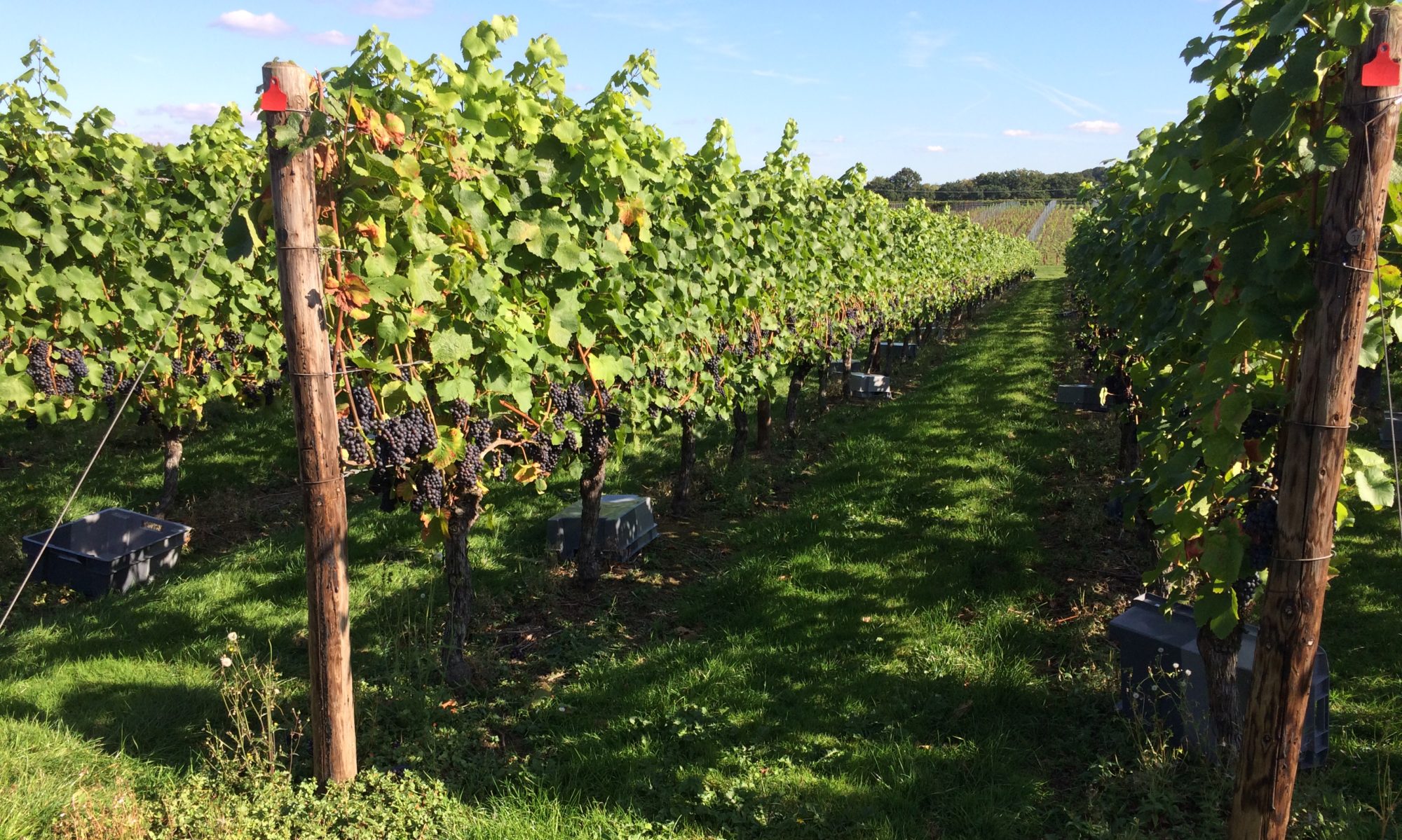
The last few weeks have finally provided some of the missing sun from this summer and have pushed on the grapes, lifting hopes of growers and winemakers. Sugar levels are below last years rather exceptional (and small) harvest at this stage. Yields are predicted to be very variable across the country and by variety. East Anglia and Kent seem to have fared best.

Pinot Noir 10/9/12

Kingscote Plantings

July 12th, 2012

After nearly a years preparation, planting finally  took place at Kingscote in the last week of May. Somewhat later than planned due to the rather wet weather. The newly dug land-drains have been proving their worth, an expensive but vital part of the vineyard infrastructure and for the long term viability of the vines.

laying land drains at Kingscote

An interesting varietal mix for still and sparkling wines have been planted, Bacchus, Seigrebbe, Pinot Blanc, Pinot Noir, Pinot Meurnier and Chardonnay. The 8000 vines were hand-planted over a 2 day period.

Bacchus vines ready for planting

Hand planting can cost less than machine planting and done by the right people is more acurate than mechanical planting. The plants establish better and there tends to be less damage. Clay soils, especially under- prepared ones  can be problematic for mechanical planting.

Planting House field at Kingscote may 2012


SEVA wine of the year 2012

June 11th, 2012

A few weeks ago I was at Plumpton with the judges of the South East Vineyards Association Wine of the Year  Competition . Chairman was Andy Howard MW (buyer for M&S) , Charles Metcalfe , Cat Lomax (laithwaites) , Lindsay Oram  and Stuart Graham ( top tasting student at Plumpton) , I was there to put in a winemakers perspective.

We started with the Dry whites(17) which included a couple of oaked wines(moving back into fashion) , followed by a much shorter flight of off dry whites (4), usually a much maligned category but when made with thought and care can be very attractive working with English acids and flavours.

Roses next(12), the full range of colours and styles from light red  to light Provencal pink, some with a touch of tannin from short maceration.

The reds(10) were a category I wasn’t looking forward to judging by what had been on offer at the EWP tasting earlier this year, true there were a couple of horrors presumably from outside the wine scheme, but In the main I was pleasantly surprised.

The sparklings both pink(11) and white(17) were pretty solid if perhaps a little on the dull side(need to check if it was a root day) .  We eventually finished at around 2pm and repaired for pint and fish and chips at the local .

Fast forward to 7/6/12  and I am driving around a damp and desolate Denbies avoiding the presumably blind driver heading the wrong way down the one way system. If there is a better example of why you should not plant in a frost pocket let me know. The damage wrought by nature over the last 20 years stretches tundra like almost as far as the eye can see, some valiant replanting is going on, but as we know there is a masochistic gene common to most English vine growers.

Anyway, time for a quick SEVA committee meeting on the vineyard app. the summer barbecue , the Cool Climate conference ( Brighton 2016) and proposed jolly to Alsace.

As the dinner and results time approaches , judges are pretty thin on the ground with apologies for absence from 3 leaving Andy Howard, Stuart and me. I nobly offer to talk about the reds and rose sections.

The corporate area at Denbies where we have been consigned to the last couple of years is quite dull, much more exciting was up in the tower with its splendid views. The staff and atmosphere is friendly enough, the helpings generous.

A young Sandhurst Bacchus 2011 from CD is first up. Young and fresh , 3 different yeasts used in the ferment but the Sandhurst terroir come through,I always think Bacchus improves with age, its good now and will only get better. Next up came a oaked wine 2009 from Denbies,(Ranmore Hill) and we were duly graced with a rare appearance from Marcus . 5% ortega, 65% bacchus 35% Pinot Gris. I thought it tasted more Ortega, not sure where the PG came from either, in the end as you end up wondering how much the oak adds to it but I enjoyed it and it was well made. A blend next from amateur growers made by Sam Linter including some of my least recommended grapes. It just worked , it got one of my highest marks .

Onto the Roses . There had been some debate on the day as to what colour roses should be and what should be judged typical. Typical to me is a dangerous path . Biddenden Gribble Bridge rose 2011  fell somewhere in the middle colourwise, attractive pink. Fresh crisp acidity with a slight tannin grip (overnight maceration if you you want this). Dornfeler and Acalon, rose is the best home for them. I would drink this with food rather than on it own.

Bolneys Pinot Noir 2011 , 12.5% ,(silver) 2011 was a great year for still winemakers, if not accountants, the crop was small , clean, high in sugar , so I have been looking forward to tasting the result though I did not expect to taste them so soon. Apparently has seen a touch of oak which I didn’t pick up on, the wine had a freshness and aromatic purity of fruit more cherry than the more typical raspberry and strawberry(tend to get these with slightly less ripe fruit). The colour was deeper and darker (more NZ?) . 2% Dunkelfelder might be one explanation.

Sams 3rd  contribution to the evening was the 2009 Lynchgate, an oaked Rondo and Dornfelder. This was the 2nd highest marked red and for what it  is ,its pretty good. Rondo is always diffcult and slightly rustic ,even with a bit of Dornfelder for finesse it will never reach the sophisticated heights that Pinot is capable of, so a good country red is what you get. Aged in 2 year old barrels with no brett.

Sparklings next, Plumptons “The Dean” (silver), labelled as a NV but 2009? I had tasted a “Dean” someweeks earlier which was somewhat meaner and leaner. Peter Morgan dully informed us that the dosage had been moved up to 13g/l  which made all the diffrence to this high acid wine. Fresh and young and pink. This was the winner of the top prize.

Runner up was the Gusbourne 2007 (silver) which showed more age and complexity and which moved some judges more than others. Both these winning wines where from Classic chamapagne grape varieties , wines from these varietals generally scored higher than seyval or mixed blends.


Medals 2012

June 6th, 2012

A reasonable return from this years entries . Balfour Brut Rose 2008 secured Gold in the Decanter World Wine Awards with an early release of the 2009 ( the Olympic Wine) gaining a Silver, the 2009 also hit high Silver in the IWSC . On the still wine front the delicious Nutbourne 2010  was also a Silver medal wionner at the IWCS.

Pruning at Hush Heath

February 9th, 2012

Having skulked in the winery for the last couple of months doing what winemakers do, it is time to venture into vineyard territory . The orchards at Hush Heath are all but finished and the team has moved into the vines. The winter up until last week has been comparatively mild and there has been some concern that this might push the vines ahead again so this cold snap is actually quite welcome. With last years frost problems we have delayed the start of pruning. This year we are leaving extra buds and sacrificial canes and the more vunerable areas of the vineyard will be laid out with candles  as the time for budburst approaches. (Mid April)

Pinot Meunier pruned leaving 4 canes Feb 8th 2012

Thawing out the boots


What Winemakers do in January..

February 9th, 2012

For the most part winemakers tend to avoid going outside in winter. January is usually too wet,early or cold to get involved in pruning, luckily there are plenty of other things that need to be done.

Having said that Dr Richard Smart and Professor Laura Mugni were poking around a few vineyards assessing the potential fungal problems in English vines. A number of vines were sacrificed for the greater good, and the nature and identification of the evidence and its implications were debated and disputed. Apparently fungal free vines are to be found in Eygpt.

The Hand of Smart

In the winery it is refining and tweaking the 2011 blends , moving them towards stability and bottling. The 2011 still wines are of a pretty high quality, at Nutbourne we have a very classy Bacchus and Sussex Reserve which should go into bottle over the next couple of months. At Hush Heath the blends have been restricted to Balfour and Nanettes Rose.

Also exercising the mind and tastebuds has been the dosage trials of the Balfour 09, think we are nearly there….

Dosage trials of Balfour 09

Peter Hayes , the Wineskills vineyard mentor visited the Hush Heath Vineyards and gave interesting advice, some of it quite illuminating and pertinent. If he hasn’t been to your vineyard you should have him round. While he was here he was co-opted into a tasting trial of the Balfour 09 vintage. (taste it at the Olymics)


Peter Hayes and RBL discuss the finer points of Balfour 09

Gusborne and Hush Heath hosted a visit from some Austrian growers, they were certainly impressed by the level of investment in the vineyards and winery as well as the high price point for English Wines. The vineyards were all family owned , small and had their own wineries. I was told that there were 60,000 vineyards in Austria and 40,000 wineries. Passing the vineyards and skills to the next generation was regarded as being fantastically important. Tasted some good and interesting wines, chardonnay, St laurent,Pinot Noir and some local varities(need to find my notes) . Natural sugar levels were high 12-13%.  Prices where from 5-10 euros for well made and distinctive wines.

Austrians viewing Hush Heath Vineyards